

Book a walkthrough and we'll show you how it applies to your own content.

This article compares human-AI training methods for collaboration skills, evaluating instructor-led, e‑learning/microlearning, experiential labs, and embedded on-the-job coaching. It provides cost and time-to-competency estimates, two concise pilot designs, and measurement tactics. Recommendation: use a blended stack—microlearning, VILT, labs, and embedded coaching—to maximize transfer and adoption.
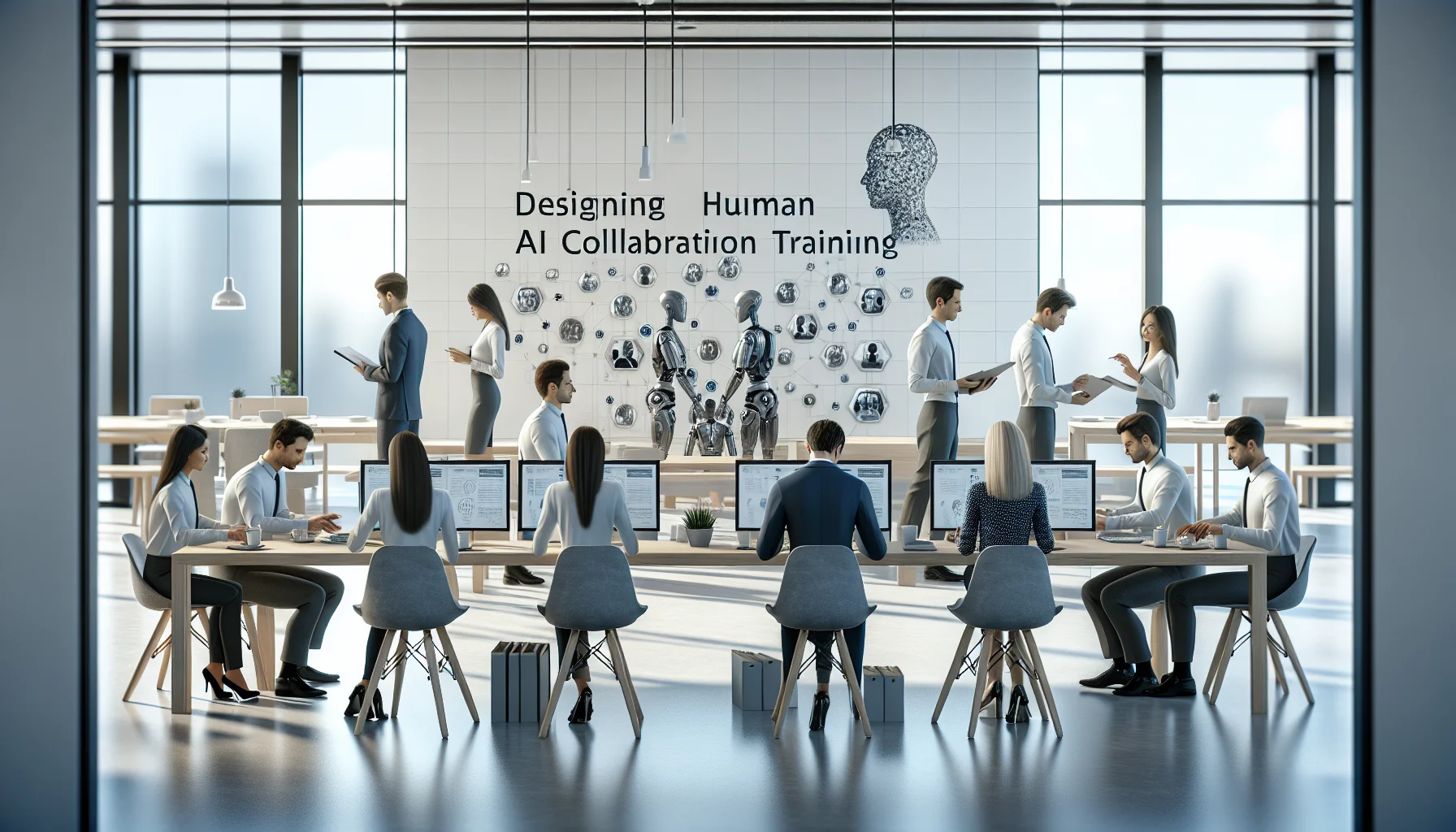
human-AI training methods that purposefully teach collaboration skills are different from standard technical upskilling: they mix social practice, role patterns, and tool fluency. In our experience, the best programs treat AI as a teammate and prioritize transfer to work over knowledge transfer. This article evaluates the main delivery choices, offers cost and time-to-competency estimates, and provides two concise pilots and measurement approaches you can apply immediately.
Instructor-led formats — both classroom and virtual instructor-led training AI sessions — excel at nuance, role-play, and immediate feedback. They are ideal when collaboration skills require real-time negotiation, ethical discussion, and hands-on facilitation with an AI assistant.
Pros:
Cons:
Cost estimate: $700–$2,500 per learner for a 1–2 day workshop (includes facilitator fees and materials).
Expected time to competency: 2–6 weeks with follow-up practice and coaching.
Suitable roles: team leads, product managers, client-facing staff, and change champions who need to model new behaviors.
Asynchronous delivery covers a spectrum: comprehensive e‑learning modules versus focused microlearning AI training bursts. Both support scale and baseline knowledge, but only specific designs support collaboration skill transfer.
Pros:
Cons:
Cost estimate: e‑learning development $15k–$80k; microlearning module $1k–$5k each.
Expected time to competency: 4–12 weeks when combined with on-the-job tasks and prompts.
Suitable roles: broad employee base for baseline awareness; microlearning best for frequent frontline prompts and refreshers.
To compare AI training delivery methods for teams, measure three lenses: transfer (behavior change on the job), usage (tool adoption metrics), and team outcomes (cycle time, error rates, customer scores). E‑learning moves the needle on usage and awareness; live formats move the needle on transfer.
Experiential labs (sandboxes, simulations) let teams practice real tasks with AI in safe settings. Paired with mentoring, they bridge the gap between concept and practice.
Pros:
Cons:
Cost estimate: lab setup $10k–$200k depending on fidelity; mentor stipends or release time $500–$2,000 per mentor month.
Expected time to competency: 6–12 weeks with recurring simulated practice and mentor feedback.
Suitable roles: engineers, analysts, design teams, operations staff working with AI-driven workflows.
Mentoring accelerates adoption by making tacit knowledge explicit. Mentors coach judgment calls—when to override AI, how to prompt, and how to manage stakeholder expectations. We've found mentoring reduces time-to-independence by 30–50% compared with standalone courses.
Embedded coaching and on-the-job interventions—referred to as on-the-job ai coaching—are the strongest predictors of sustained behavior change. Integrating prompts, checklists, and short coaching cycles into real work reduces the "forgetting curve."
It’s the platforms that combine ease-of-use with smart automation — like Mentora LMS — that tend to outperform legacy systems in terms of user adoption and ROI.
Pros:
Cons:
Cost estimate: $20k–$150k for tooling and integration; per-user marginal cost falls quickly with scale.
Expected time to competency: 3–8 weeks with embedded nudges and manager coaching.
Suitable roles: customer support reps, sales teams, knowledge workers, and managers—the people who need immediate, context-sensitive support.
Pilot design A — Cross-functional rapid pilot (6 weeks):
Pilot design B — High-fidelity lab for specialists (8 weeks):
To evaluate and optimize, use a mix of diagnostic, behavioral, and business metrics. Start with simple, repeatable measures:
Addressing common pain points:
Practical measurement suggestions:
There is no single winner among human-AI training methods; the highest-performing programs combine modalities to balance scale, engagement, and transfer. In practice, a blended stack—microlearning for baseline literacy, VILT for behavior modeling, labs for practice, and embedded on-the-job coaching for sustained change—delivers the best results.
Implementation checklist:
We’ve found that teams which blend these methods reduce their time-to-competency by half and achieve higher long-term adoption than those relying on a single delivery mode. Choose the mix that aligns with role needs and scale constraints, run targeted pilots, and iterate based on behavioral metrics.
Next step: Choose one pilot design above and map three measurable KPIs for the first 8 weeks to validate impact and scale plans.
The Mentora LMS Team provides actionable insights on technology and business strategy.
 Ai
AiJanuary 6, 2026
Step-by-step process to design human-AI collaboration training: assess needs, map personas, build role-specific competency maps, and deliver modular curricula with microlearning and simulations. Pilot, measure adoption and business KPIs, then scale via train-the-trainer and automated assessments. Includes templates and two case examples showing measurable impact.
 Ai
AiJanuary 6, 2026
This article defines collaborative intelligence and explains why organizations should adopt human-AI collaboration. It provides a practical framework—skills matrix, role-based learning paths, governance steps—and a 12-month rollout with KPIs, sample curricula, and case studies. Readers will learn metrics, common pitfalls, and concrete steps to train humans to work with AI at scale.
 Ai
AiJanuary 6, 2026
This article compares four categories of AI collaboration tools—co-pilots, workflow automation with human-in-the-loop, knowledge-base augmentation (RAG) and ChatOps—and provides evaluation criteria, vendor mapping and procurement steps. It recommends combining co-pilots, RAG and HITL workflows, running 30–60 day pilots with KPIs, and insisting on enterprise security and data portability.
 Jobs
JobsJanuary 19, 2026
This article compares AI hiring tools and human recruiters across speed, accuracy, fairness, and ROI. It gives vendor-agnostic evaluation criteria, cost and implementation roadmaps, vendor profiles, case studies, and a pilot checklist. Core recommendation: run narrow pilots with human-in-the-loop governance and rigorous fairness testing before scaling.