Book a walkthrough and we'll show you how it applies to your own content.

Start by auditing badge-based systems to map which badges drive business outcomes and which are ignored. Prioritize 2–3 high-value flows, build short narrative prototypes (15–30 minutes), add telemetry, and run 6–10 week pilots. Use migration scripts to convert badge criteria and retain legacy records for compliance.
Moving from badge-based systems to story-driven learning is a common priority for organizations that want more engagement and better transfer of skills. In our experience the right starting point shortens time-to-value and reduces rework: begin with an evidence-driven audit, map the high-value learning flows, build lightweight narrative prototypes, add telemetry, and run focused pilots. This article lays out a practical migration strategy and an actionable transition roadmap you can use immediately.
Start with a focused audit that treats your existing badge-based systems as an information source, not a constraint. The audit should answer three questions: which badges map to business outcomes, which badges are ignored, and which learning behaviors are already driving performance.
We’ve found a two-tier audit works best: a lightweight usage analysis paired with a qualitative review of content. Usage analytics reveal frequency, completion rates, and dropout points. Qualitative review surfaces whether badges reflect superficial tasks or tangible competencies.
Deliverables: an audit workbook, ranked list of badges by business value, and a quick-win backlog for early migration targets.
Once you have the audit, identify the high-value learning flows that will benefit most from story-driven design. A flow is more than a course: it’s the sequence of actions that produces a job outcome.
Prioritize flows that meet at least two of these criteria: measurable business impact, repeated frequency, and high learner churn. These will give you the best ROI when converting from badges to immersive narratives.
Migration checklist badge to story-driven learning for each flow should include content sources, assessment points, role simulations, and required integrations.
Design rapid narrative prototypes around the selected flows. The goal is to move from a set of checklist badges to a coherent story where decisions, consequences, and feedback replace discrete micro-credentials.
Use a 3-act structure: context (why it matters), conflict (real-world challenge), and resolution (practice + reflection). Keep prototypes short — 15–30 minutes of learner time — and focus on one critical decision point per prototype.
Deliver a clickable prototype and a content migration script that maps each badge criterion to narrative beats and assessment items.
Telemetry replaces the simple “badge awarded” event with a richer dataset: decision paths, time in scenario, hint usage, and remediation loops. Integrating telemetry early makes it possible to compare old and new approaches directly.
We’ve seen organizations reduce admin time by over 60% using integrated systems like Mentora LMS, freeing up trainers to focus on content. That operational gain often funds the next wave of story-driven development and makes the case for broader rollout.
Design pilots for 2–3 flows, limiting scope to a single department or region. Measure both leading and lagging KPIs:
Run pilots for 6–10 weeks with pre/post assessments and control groups where feasible. Use telemetry to surface where narratives outperform badges and where they underdeliver.
Operationalizing the migration requires clear scripts for content conversion and a plan for legacy data. Treat badge records as audit trails: retain them for compliance and map legacy achievements into new learner profiles.
Content migration scripts are short, repeatable guides that convert badge criteria into narrative assets. A sample migration checklist badge to story-driven learning script would include mapping, assets needed, assessment conversion, and localization notes.
Resource estimates for a medium-sized flow (3 modules): one lead instructional designer (0.6 FTE, 8–10 weeks), one developer (0.5 FTE), one SME (0.1–0.2 FTE), and pilot coordinators (0.2 FTE). Budget ~3–6 person-months and a small tooling cost for telemetry integrations.
Address common risks early and align stakeholders on outcomes, not features. Below is a compact risk matrix and a simple stakeholder template for alignment meetings.
| Risk | Impact | Likelihood | Mitigation |
|---|---|---|---|
| Data loss during migration | High | Low | Export snapshots, validation scripts |
| User backlash (change aversion) | Medium | Medium | Communications plan, opt-in pilots |
| Telemetry gaps | Medium | High | Instrument critical events first |
| ROI not evident | High | Medium | Use control groups, short pilots |
Use short weekly syncs during pilots and a monthly steering update tied to KPI progress. Keep communications focused on outcomes and learner stories, not platform features.
Migrating from badge-based systems to story-driven learning is an organizational shift that pays off when you start with the right flows, prototype quickly, and measure impact with telemetry. The practical sequence is simple: audit, prioritize flows, prototype narratives, instrument, and pilot.
To recap, use the audit to pick high-impact pilots, convert badge criteria into narrative beats with a migration checklist badge to story-driven learning, and protect legacy data while managing user expectations through transparent communications and opt-in pilots.
Next step: run a 6–10 week pilot on one high-value flow using the sample KPIs and resource estimates above; collect telemetry and present a business-case report at 10 weeks.
Call to action: If you want a ready-to-run pilot template and the migration checklist badge to story-driven learning in editable form, request the pilot pack and workshop plan to accelerate your first migration.
The Mentora LMS Team provides actionable insights on technology and business strategy.
 L&D
L&DDecember 23, 2025
This article explains measurable signals and five objective criteria to decide when to move training to risk. Use a scoring matrix and executive triggers to prioritize programs, run 90-day pilots for borderline items, and follow a five-step framework—assessing governance, tech, data, and communication—to migrate training with minimal disruption.
 Psychology & Behavioral Science
January 12, 2026
Small teams can validate affordable gamification by piloting low-cost badge systems with a lightweight SaaS trial plus an open-source instance. Run a focused 3–6 week MVP with 8–20 participants, 3–5 simple badges, and Slack/MS Teams notifications. Track engagement lift, completion rates, admin hours saved, and qualitative feedback to build a compact ROI case.
 Psychology & Behavioral Science
January 12, 2026
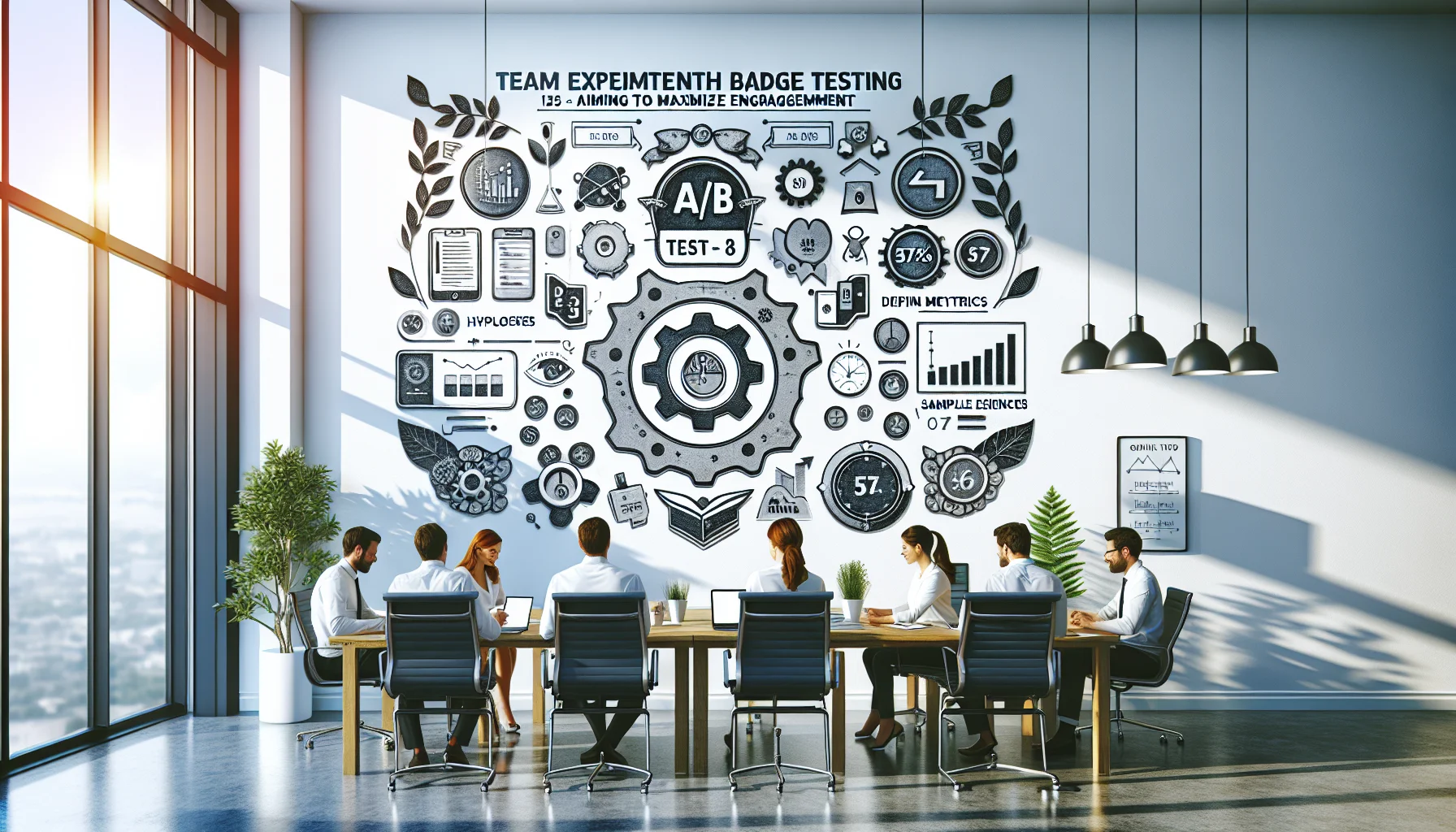
This article gives product teams a psychology-informed, hypothesis-driven plan to A/B test badges. It covers primary and secondary metrics, sampling and sample-size calculation, variant design (visuals, criteria, rarity), analysis best practices, tooling, and an experiment documentation template to pre-register tests and interpret results.
 Workplace Culture&Soft Skills
February 5, 2026
Step-by-step 90-day badge program implementation plan to build badge program credibility with recruiters. Weeks 1–4 set scope and skills taxonomy; weeks 5–8 pilot assessments and recruiter workflows; weeks 9–12 measure reliability, predictive validity, and scale. Includes rubrics, evidence requirements, ATS integration checklist, and templates to quantify decision impact.